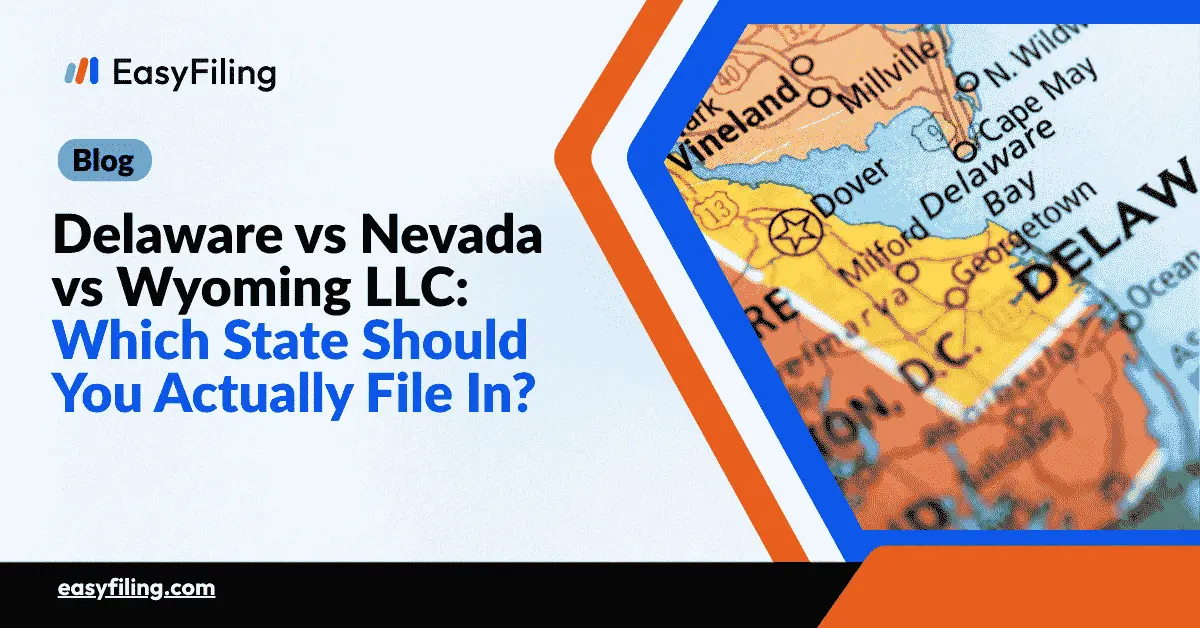
Wyoming and Delaware are both popular options because each has its own strengths. Wyoming is less expensive overall, and Delaware is well respected among the banking and investment community. The main difference with respect to Nevada is that it usually costs more, and non-residents don’t receive any preferential treatment. The majority of the clients we work with end up in Wyoming or Delaware.
All else being equal, there are only two real considerations for business owners when deciding which entity to incorporate. The first is how much it costs. The second is how much privacy I want.
Because we help founders incorporate worldwide, we are very familiar with LLC questions in Delaware, Nevada, and Wyoming. Here are the answers, based on our experience with client entities.
What Each State Actually Costs
These costs are usually surprising to founders. Most marketing pages only list the state filing fee. There are other costs associated with forming the entity. Each year, there are recurring costs associated with maintaining the entity. If a state tax is late, the state charges a penalty and interest.
Delaware charges an annual franchise tax of $300. As long as it is paid, Delaware does not charge a penalty. If it is not paid, Delaware charges a $200 penalty and 1.5% interest per month.
While the state formation fees for Nevada and Wyoming are comparable, Nevada’s costs quickly surpass Wyoming’s once the formation process begins. Nevada charges for an Initial List and a Business License, bringing the total formation costs to approximately $436.
Subsequent annual costs to maintain the LLC include an Annual List fee of $150 and a business license renewal fee of $200, for a total of $350. Miss the anniversary of either of these, and you’re looking at a combined total of $175 and default status for your LLC.
At $103, the cost for Articles of Organization in Wyoming is even less than Nevada’s formation costs, and annual reports for Wyoming companies are only $0.0002 of the company’s total asset value. For most companies, this means an annual report of $0.00. And unlike Nevada, Wyoming imposes:
- No inheritance or gift taxes
- No personal income tax
- No property taxes
- No state corporate income taxes
- No state unitary taxes
Compared to the other two, Wyoming offers the greatest savings in forming and maintaining a company over a five-year period. Delaware’s franchise taxes and Nevada’s business license renewal quickly eat away at potential company savings.
Which State Do Investors and Banks Actually Prefer?
According to many lawyers and businesspeople, Delaware is the preferred state for incorporating or forming an LLC. Most U.S. venture capitalists will prefer to work with Delaware corporations over LLCs in other states. Delaware courts and their business law cases help resolve disputes more quickly, which gives banks and other financial institutions greater confidence. According to our clients’ experience, Delaware and Wyoming receive less scrutiny during KYC, while Nevada receives more, especially since it is known as the place to form shell companies.
If you are trying to open a U.S. bank account while living outside the country, the state in which you form your LLC becomes even more important. Based on our experience with bank underwriting, a company formed in Wyoming or Delaware is preferred to one formed in Nevada.
Privacy: Where Nevada and Wyoming Actually Win
When it comes to forming an LLC and keeping members’ names private, Nevada and Wyoming beat Delaware. While Delaware doesn’t require you to name LLC managers or members in the papers you file, it does require a registered agent.
In practice, this occurs later. Wyoming does not require state-level reporting to expose ownership, and so records are not publicly available. In contrast, while the managing members of Nevada entities are not required to be disclosed to the public, Nevada’s filing requirements require disclosure of their names; therefore, they are public record. Because of this, Wyoming offers more privacy. Because Nevada charges a higher filing fee, overall formation costs in Wyoming are lower.
Neither of these considerations alters the requirement for entities to report beneficial ownership to FinCEN.
Registered Agents and Physical Presence Requirements
All of the states require a registered agent and a physical address for the registered agent. The registered agent cannot be the entity or the entity’s manager and cannot be located outside of the state. The cost of registered agent services for a given year ranges from $50 to $300 and is similar across all states.
Wyoming and Nevada are attractive for entities with no physical presence in the United States. If your entity has a physical presence in the United States, for example, in Texas, you should form it in Texas.
Common Mistakes Founders Make When Choosing Between These States
Below are common errors we see founders make when choosing among business entities.
There are a number of reasons Delaware might make sense for your business; however, if you do not intend to raise outside capital, Delaware likely does not make the most economic sense for you. For example, the entity taxes you $300/year, and that may be an unnecessary expense for your business.
Nevada, on the other hand, is not a good choice for asset protection, given the costs of forming the entity. Wyoming offers similar protections at a lower cost. We rarely see a good reason for a founder to choose Nevada over Wyoming.
There are a few mishaps that are unique to each state. For Delaware, the main thing people forget is that the franchise tax has a hard deadline of June 1st every year, regardless of when the company was formed. Nevada and Wyoming’s annual reports are due in the anniversary month of the company’s formation. A couple of our clients have had problems with their first annual reports because they assumed the deadline was based on the calendar year.
A registered agent renewal is something people tend to forget. It happens every year in all three states and adds an additional cost of $50 to $300. Lastly, in terms of costs, Delaware is typically the most expensive state, with Nevada and Wyoming being comparable to each other. Wyoming and Nevada don’t charge an income tax on LLCs, and Delaware does. Some investors are more comfortable with companies being formed in Delaware, but that is rapidly changing.
Delaware vs Nevada vs Wyoming: Side-by-Side Cost Comparison
How to Actually File, Step by Step
- Search your proposed LLC name in your state’s business name database to see if it is available.
- Appoint a registered agent in the state.
- File the LLC formation document with the state.
- Pay the state the filing fee and, if you wish, expedite the processing of your document.
- Once your LLC is approved by the state, complete and file Form SS-4 with the IRS to obtain a federal Employer Identification Number (EIN). If you do not have a Social Security Number or Individual Taxpayer Identification Number (ITIN) and you are not a resident of the U.S., you can mail or fax the completed form and get your EIN in 4 to 6 weeks.
- Open a business bank account in the U.S.
- Calendar the due date of your first annual report and franchise tax.
Our Actual Recommendation
Wyoming is the least expensive state for forming and annually maintaining a foreign LLC in terms of total costs and provides adequate legitimacy with U.S. banks. Delaware is more respected within the venture capital and institutional banking communities, thereby justifying the additional $240 annual cost to maintain a foreign LLC. Nevada is a very expensive state in which to maintain a foreign LLC annually and is not recommended for non-resident LLCs.
Ready to File?
EasyFiling provides a full suite of services to form, maintain, and dissolve foreign LLCs in Delaware, Nevada, and Wyoming. Prior to engaging our services, our staff is available to review your specific situation to assist you in making the best decision for your situation.
FAQs for Delaware vs. Nevada vs. Wyoming LLC
“This content is for informational purposes only and does not constitute legal, tax, or financial advice. For advice specific to your situation, consult a qualified US attorney or CPA.”
File Your LLC Today
25$ off with a coupon
Lock in EasyFiling's transparent rates and get lifetime compliance support at no extra cost.
Get Started Now
Swostika Silwal