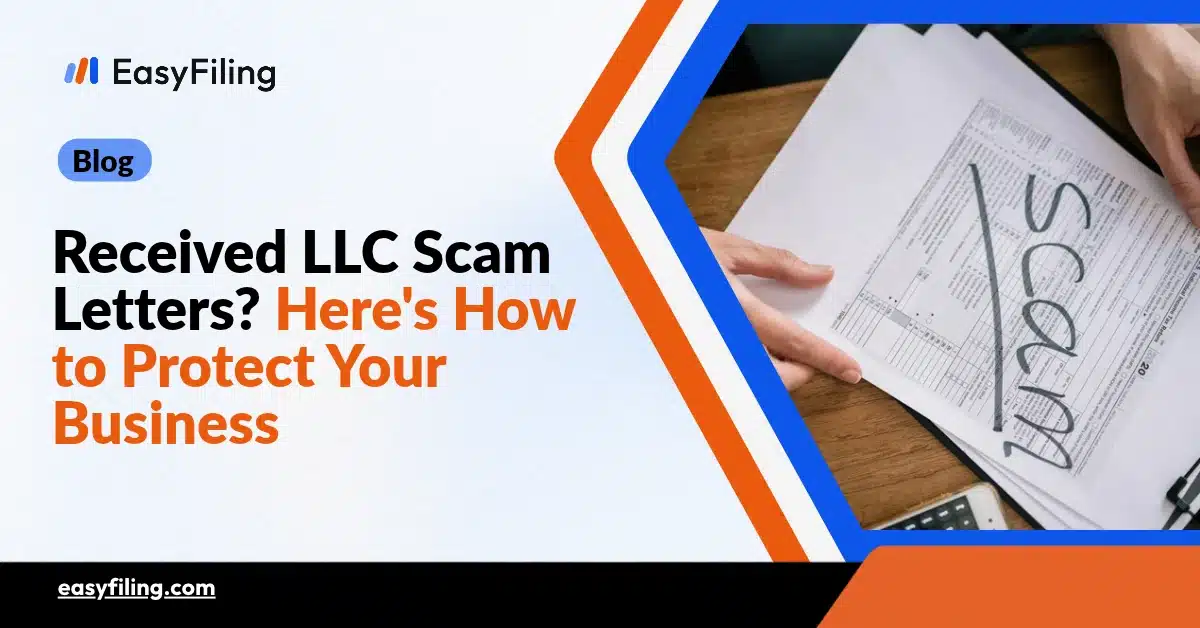
If you received an LLC scam letter, do not pay it, call the number on it, or scan its QR code. Look up the requirement yourself on your Secretary of State’s website or IRS.gov, and report the letter to the FTC. Most of these letters are private mailers built from public state filings that charge a fee for something the state handles for free or for far less. Real notices come from the IRS, your Secretary of State, or your registered agent.
LLC scam letters look more official than the real mail, and many are mailed soon after your company appears in the state’s business search. Your LLC’s name, formation date, and your registered agent’s address are in the public record. Anyone can obtain them and print letters with an official-sounding name, a due date, and a fee.
We see the scam letters often enough to spot the patterns. The scam letters are easy to spot once you know where to look. The real, and often costly, notices are the harder problem.
Why does a new LLC get so much junk mail?
Public records of LLC formation are in all state records. LLC mailers are sent because the new owners are often unaware of the state processes and procedures. The new owner, who may also live in a different state or country, is a better target. A “final notice” creates a sense of urgency when state processes and procedures are unknown.
Letters usually go to the registered agent’s address or the address listed in the formation document. If that address is your home, junk mail is delivered there. Use a registered agent service and/or a virtual address to have mail delivered to a different address and to someone who sorts mail. It doesn’t remove you from public records, so mail keeps coming. You just see it in the context of why the people sending you the mail are sending it to you.
What do LLC scam letters actually look like?
They generally fall into a few patterns. Here’s what we see the most of and what is generally true of each as of October 2026.
| Type | What it claims | What it asks for | What is actually true |
|---|---|---|---|
| Annual report mailer | You must file an annual report or “minutes statement” | A preparation fee, often $75 to $95 | Mississippi’s Secretary of State warned about mailers charging $75 (2021 reports) and $95 (2022 reports). Mississippi LLCs file online at no cost, due April 15. |
| BOI compliance notice | You must report beneficial owners on “Form 4022” or “Form 5102” | A fee, personal data, or a QR code scan | FinCEN says there is no fee to file BOI, no Form 4022, and no agency called “US Business Regulations Dept.” |
| EIN or IRS lookalike | Your EIN needs “registration” or “verification” | A paid service fee | The IRS issues EINs at no charge. |
| Trademark notice | Your mark needs registration or renewal | Hundreds of dollars to a private address | Real USPTO email comes from @uspto.gov, and fees go to the USPTO. |
The mailer we see the most is for the annual report. The tell is in the fine print. Most of these mailers include a brief disclaimer stating that the sender is not affiliated with any state agency. The letters usually say “final notice” on the first line and “advertisement” on the last line.
The BOI letters deserve their own warning. As of FinCEN’s March 2025 update, entities created in the United States are exempt from BOI reporting. That means a BOI letter requesting action from a Wyoming or Delaware LLC asks for something that is currently not required. That status can change, so check the BOI page on FinCEN. As for the fee, there is currently none. The EIN version is more subtle. Letters or websites state they will “register” your EIN for a fee.
So how do you spot an LLC scam letter?
For any letter you are not familiar with, perform these 5 checks. It usually takes less than 10 minutes.
- Check the sender line and the smallest print. Look for disclaimers and return addresses, P.O. boxes. Look for company names that sound like state agency names. The seal and name of the actual state agency will be on authentic mail from a state’s Secretary of State.
- Check for misspellings and grammatical errors.
- Check for potential out-of-state phone numbers.
- Scan for stamps and signatures.
- Check the website and email address.
Check the amount, who gets paid, and the deadline
Examine the amount enclosed against the state’s official fee. The difference between the state fee and the amount charged by the letter sender is the sender’s profit. The table below shows the actual cost of real obligations.
Check who gets paid. Real payments are made to a state agency or to the U.S. Treasury through the state agency’s website. A check made out to an LLC or to a private company is a major red flag.
Look up the requirement yourself. Open the Secretary of State’s website or IRS.gov in a new browser window. Do not use the phone number, link, or QR code printed on the letter.
Check the deadline against your formation date. Many states set the deadline for annual reports based on the formation month or a set date. A deadline that is not based on either is likely made up.
What real obligations cost (as of October 2026)
| Obligation | Official cost | Who gets paid | Deadline |
|---|---|---|---|
| EIN | $0 | IRS | Once, after formation |
| Mississippi LLC annual report | $0 online | Mississippi Secretary of State | April 15 |
| Wyoming LLC annual report | $60 minimum license tax | Wyoming Secretary of State | First day of your formation anniversary month |
| Delaware LLC annual tax | $300 | Delaware Division of Corporations | June 1 |
| BOI report | $0 | FinCEN | Not currently required for U.S.-formed companies |
State fees change, so confirm the current figure on the state’s website before you pay.
Which actual letters look like scams?
This is what costs founders the most. Legitimate notices can look worse than fraudulent ones, and people who disregard them often assume they are scams.
The IRS makes first contact via mail. A real IRS letter includes a notice number in the top-right corner and a request for payment to the U.S. Treasury, not to a person or a gift card. A single-member LLC owned by a foreign person must file Form 5472, and the IRS can assess a $25,000 penalty for each Form 5472 that is not filed on time or at all. That letter looks like a scam, but it isn’t. If you are not sure of the amount you owe, our U.S. tax filing team can review the notice with you.
There are real letters from the states as well. Failing to file a delinquent annual report can result in the administrative dissolution or revocation of your business and the loss of your business’s good standing.
There are also legal notices. When someone sues your LLC, the court summons is served on your registered agent, who forwards it to you. The response period is 20 to 30 days from the date the court issues the summons, so assuming it is junk can be costly.
Our rule is also simple. A threat of a penalty is real. You have to confirm it against the agency’s site.
You receive a letter that looks suspicious. What do you do?
- You want to avoid contact with anything on the letter or envelope. Don’t pay, call, scan, or do anything with the QR code. The phone number and QR code are the ways scam artists use to access your account.
- Hang onto the letter and envelope. The postmark and return address may be useful when you file a report.
- Check with the agency. Search the state’s business portal or IRS.gov yourself.
- Report it. File a report with the FTC at https://reportfraud.ftc.gov. The Mississippi Secretary of State’s office forwards reports of solicitation to the state Attorney General. Likewise, most states have an office like this. For trademark mail, report the scam to the USPTO at TMScams@uspto.gov.
- If money was sent, call your bank or card issuer to dispute the charge the same day you receive the letter. The quicker you report and file disputes, the better.
What other mistakes do founders make with fake LLC notices?
- Meeting deadlines. Letters are set to scam within days. Real agency deadlines are public.
- Trusting details. The LLC name, EIN, and formation date are public records and do not prove anything.
- Giving personal data. No real agency would have you mail a QR code to capture your ID number.
- Allowing mail to pile up. Real and fake letters get the same treatment and ultimately expire.
- Assuming a letter to the registered agent’s address is official. The address is public, so anyone has it.
Have a letter you don’t know what to do with? Contact us for a consultation, and we can tell you if it is legitimate before you spend any money.
Common Questions About LLC Scam Letters and Fake Notices
Are LLC scam letters legal?
It is legal to send LLC scam letters, but many admit in the fine print that the letter is from a private company. There have been cases of people convicted of mail fraud for creating company names similar to those of government agencies, including one in 2021.
How do they get my LLC information?
They get it from public state records. Anyone can look up the formation date, name, and address of the registered agent. Scammers purchase or copy this information in bulk.
Do I have to file a BOI report?
According to FinCEN’s March 2025 update, entities formed in the U.S. are exempt. Check their website for the latest information. Letters requesting a BOI report are fraudulent. FinCEN does not charge a fee for BOI reports.
What if the letter contains my EIN or formation date?
It is still a scam. Public records and data brokers contain this information. Contact the agency directly to verify.
What happens if I scan the QR code?
Close the web page without entering any information. If you entered information, change your password on the account, monitor your accounts, and report it to the FTC.
Can my registered agent filter out scam mail?
A good registered agent forwards legal and governmental mail. Ask your registered agent to do the same.
I travel a lot. Who should I keep copied on what?
It depends on who you’re traveling with. Have your lawyer send legal documents to your registered agent.
“This content is for informational purposes only and does not constitute legal, tax, or financial advice. For advice specific to your situation, consult a qualified US attorney or CPA.”
File Your LLC Today
25$ off with a coupon
Lock in EasyFiling's transparent rates and get lifetime compliance support at no extra cost.
Get Started Now
Swostika Silwal