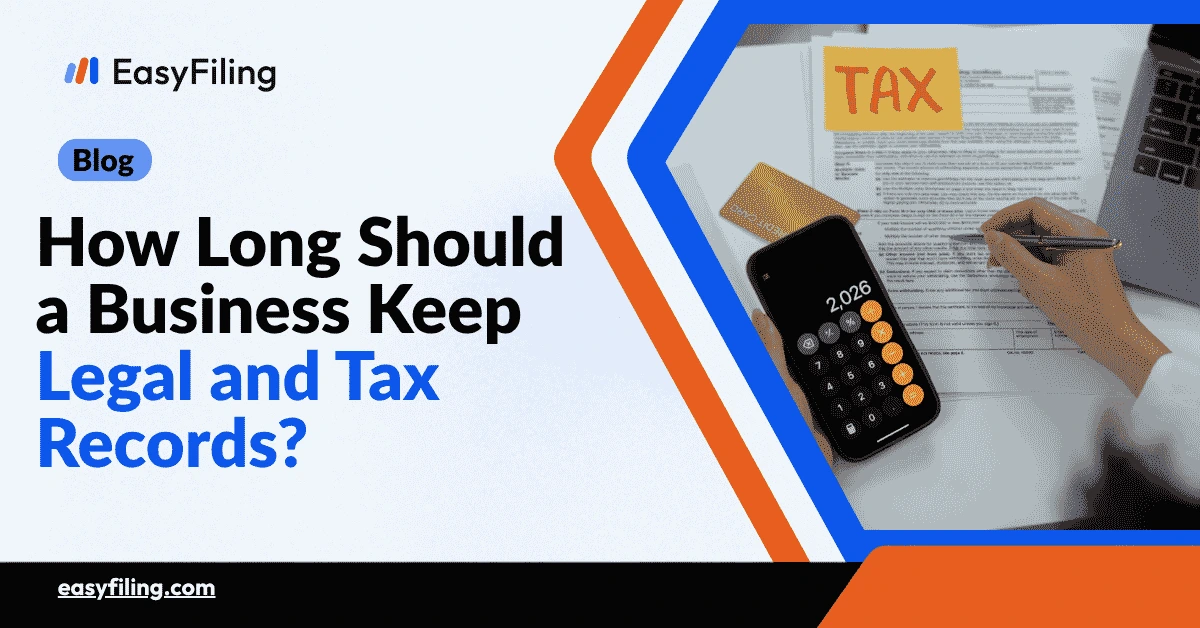
The most common retention terms for business records are 3 and 7 years. In general, retain tax and financial records for 3 years to cover the IRS’s statute of limitations, and 7 years to protect against claims of underreported income and bad debt. Formation agreements, organizational documents, and any documents related to litigation should be retained indefinitely, since there is no statute of limitations for establishing an owner’s identity.
Founders ask us this question every day, especially after receiving an IRS notice requesting a document they disposed of two years ago. EasyFiling helps US resident and non-resident founders who control US limited liability companies from abroad every day. The response time for such requests can range from five minutes to six weeks, which is why it is essential to know in advance what to keep and where. Below is a checklist of what to retain, guidelines on retention periods, and the most common business document retention mistakes.
IRS Guidelines to Retain Records
The retention terms set by the IRS are time limits for how long taxpayers must retain supporting documentation after filing a tax return. This means the clock starts on the date of filing or, if the tax return was filed early, on the due date. For example, a 2025 tax return filed in February 2026 is subject to a statute of limitations that begins on April 15, 2026, not on the filing date.
Below is a list of retention terms that apply to most businesses:
- 3 years from the filing date, an appropriate duration to retain most tax returns
- 6 years, if a taxpayer underreported gross income by more than 25%
- 7 years for bad debts or worthless securities deductions
- 4 years, for employment tax records, including Forms 941 and W-2
- Indefinite, for tax returns that were not filed, or that were fraudulent
Most tax compliance teams, including ours, recommend retaining tax-related records for 7 years unless there is a specific need to retain them longer. The main advantage of a 7-year retention period is that it safely covers tax-related audit exposure while also reducing complexity, since documents do not have to be separated into groups based on different retention periods.
Formation-Related and Other Records Retention
Although tax-related audit exposure dictates most retention terms in business, another factor determines the need for record retention. Most jurisdictions require retaining formation and ownership-related documentation for as long as the entity is operational.
Below is a list of documents that should be kept indefinitely or for a period that extends beyond regular business operations:
- Formation agreements and organizational documents
- Operating agreements
- EIN confirmation letters (CP 575 or 147C)
- Stock and membership ledgers
- Meeting minutes and resolutions
- Intellectual property-related records
We often assist our clients in retrieving records needed more than 5 years after a business’s formation. It is critical to remember that most registered agent services do not retain documents for you, which is why it is essential to store a copy of your formation-related records in another secure location, such as with the company that formed your LLC. If you need to request a duplicate of your formation documents, such as Articles of Organization, obtaining it from the Secretary of State may take up to 4 weeks, depending on the state.
What Records to Retain for 7 Years?
The most common retention period that covers the majority of audit exposures is 7 years. Below is a list of records that should be retained for this duration.
| Record Type | Reason |
| Bank statements and reconciliations | Support deposits, payments, expenses, and other items claimed on a tax return |
| Accounts payable and receivable records | To verify bad debt deductions |
| Payroll tax filings and W-2, 1099 forms | To cover federal and state tax-related audits |
| Depreciation schedules for assets | Depends on the asset’s useful life plus the period of its disposal |
| Receipts for expenses over $75 | The IRS’s minimum standard for deductible expenses |
| 1099-NEC and 1099-MISC issued to a contractor | Backup for withholding and IRS audit needs |
What Records to Dispose of After 3 Years?
The following categories of records can be disposed of after 3 years:
- Duplicate receipts: if bank statements are reconciled, there is no need to retain receipts that are duplicates of payments already listed on the statements
- Expired policies: if there are no claims, expired policies, including insurance and warranties, can be disposed of
- Canceled contracts: once a contract is superseded by another document or fully performed, it can be disposed of
- Drafts of documents that were finalized: retention of such records may be determined separately by the company’s own record retention policy
Once business records reach the end of their required retention period, companies should dispose of sensitive paperwork securely. California businesses can use professional document shredding in Oakland to help prevent confidential financial, employee, or customer information from falling into the wrong hands.
We advise our clients to err on the side of caution, as it is better to retain documents for longer than to risk being unable to retrieve a record when a government agency requests it. The next set of frequently asked questions addresses the most common record retention mistakes.
Common Business Document Retention Mistakes
The following mistakes are among the most common ones related to document retention:
- Believing that digital is automatically safer. Being digital is not inherently unsafe, but saving documents as PDFs in one’s Gmail is not exactly a secure retention strategy. If that email account is deleted or hacked, the records are lost for good. The IRS has specific requirements for electronic records, including that they must be legible upon request, which means a reliable backup is necessary.
- Thinking the registered agent is responsible for retaining records. The registered agent forwards legal and tax documents but is not responsible for retaining them.
- Disposing of all documents when a business is dissolved. A company’s liabilities do not disappear simply because the business was dissolved intentionally. The state and the IRS may request documents at any time, including several years after dissolution.
- Mixing personal and business records. A common mistake among non-resident founders is retaining business documents in the same accounting software used to prepare tax returns in another country.
- Losing a CP575 or 147C letter. This is the most common request we receive from our clients, as banks, processors, and state agencies that need to verify a taxpayer’s EIN often ask for it, and obtaining a new one from the IRS can take several weeks for a non-US founder.
State-Specific Record Retention Requirements
The requirements described above apply to both federal and state tax laws. In addition, some states have stricter requirements than the IRS. For example, California requires employers to retain payroll records for 4 years under the California Labor Code. New York’s sales tax records must be retained for at least 3 years, although in practice auditors often request more documents than the law requires.
If an LLC operates in several states as a foreign entity through foreign qualification, it should be aware that it is subject to all applicable state-specific record-retention requirements.
FAQs
Do I need to keep paper copies, or is it enough to store electronic files?
Electronic records are acceptable, provided they are not password-protected, are legible, and can be retrieved readily upon request.
If I lose a record during an audit, can I reconstruct it based on bank statements and other information?
Even if the original document is lost, the IRS can still audit or disallow the related deduction or income, which would require reconstructing it based on the information at hand.
Do I need to retain records even if the LLC has been dissolved?
Tax authorities can request records at any time, even after the LLC has been dissolved, so it is critical to retain all documents for the entire duration of the LLC’s operations.
Are there any differences in document retention rules for non-resident founders?
Document retention rules are the same for all taxpayers, regardless of residency status. The main difference is that it takes longer to reissue a document to a non-resident taxpayer.
Is it advisable to keep records beyond the statute of limitations?
It is important to retain formation and ownership-related documents indefinitely. For other records, it is advisable to keep them for at least 7 years, since audits can take that long to conduct. Extending the retention period a few years beyond the minimum requirements is not detrimental to the business.
If you are unsure what to retain, what to dispose of, and where your original formation documents are, EasyFiling can help you compile a complete set of compliance-related documents for your LLC, so you will not spend sleepless nights searching for a CP575 before a bank meeting.
“This content is for informational purposes only and does not constitute legal, tax, or financial advice. For advice specific to your situation, consult a qualified US attorney or CPA.”
File Your LLC Today
25$ off with a coupon
Lock in EasyFiling's transparent rates and get lifetime compliance support at no extra cost.
Get Started Now
Swostika Silwal