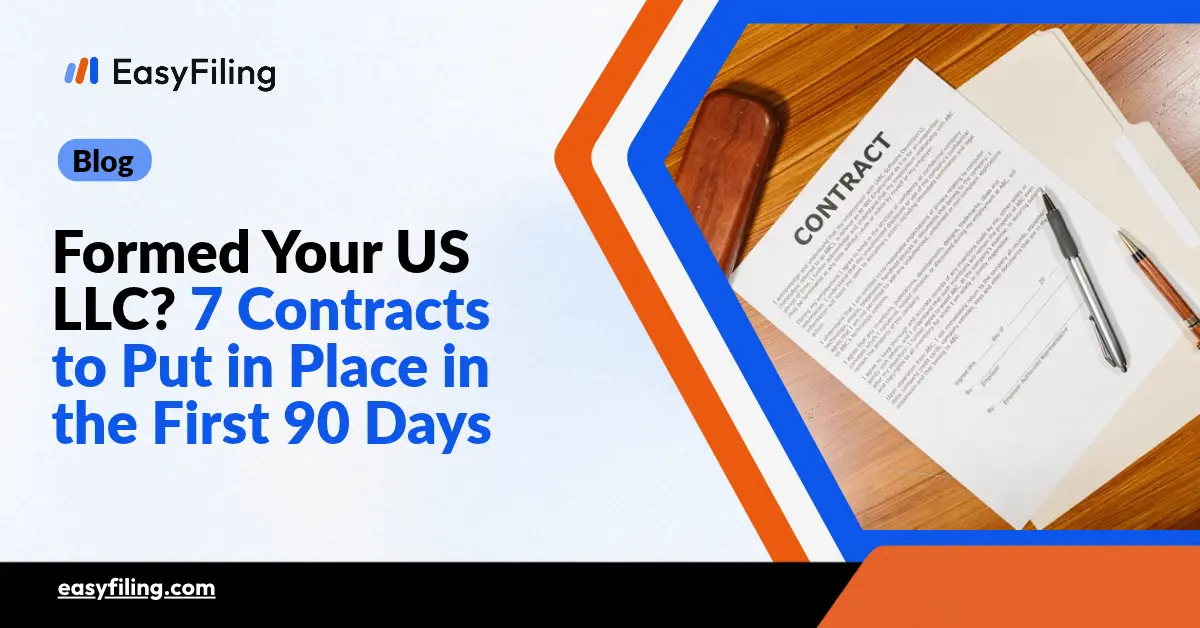
The contracts a new LLC needs in its first 90 days are an operating agreement, a founders’ or shareholders’ agreement, an NDA, an independent contractor agreement, a client services agreement or SOW, vendor terms, and website terms. Sign your operating agreement first, and your contractor and client contracts before any services are performed. Website terms should be in place before your website launches.
If you have formed an LLC and have your EIN, you are in business. However, you may still have no idea who the legal owners of the business are, who owns the work your contractors produce, and what remedy you have against your clients for non-payment. Contracts resolve these legal uncertainties.
For foreign nationals who form US businesses, contracts are especially important. A US bank or payment service provider may ask to see these documents prior to allowing you to use their services.
Why Contracts Come Right After Formation
Contracts, a bank account in the LLC’s name, and other agreements constitute the records of how the LLC is operated as a separate business. “Jane Doe, Member, ABC LLC” on a signature line protects you more than “Jane Doe” does.
Contracts alter how others perceive you. Banks are interested in business ownership, and larger clients want to see a signed agreement prior to making payment to a new vendor. Our guide on what to do after forming an LLC covers the next steps once your company is official.
The 7 Contracts a New LLC Needs
1. Operating Agreement
The operating agreement governs the rules for running your LLC. It functions similarly to a partnership agreement or shareholder agreement for a corporation. When you create an LLC, you do not file the operating agreement with your state. You keep it for your records.
Most states do not require you to create a written operating agreement, but New York is one of the states that requires it. Single-member LLCs should also create an operating agreement to preserve the legal fiction that the LLC and its member are separate entities.
2. Founders’ or Shareholders’ Agreement
An agreement among founders of an LLC functions similarly to a co-founder agreement for a corporation. It covers topics such as vesting, decision-making rights, and share purchases. This type of agreement is usually included in the LLC’s operating agreement.
When a corporation creates shareholder agreements, they function similarly to stock option agreements in a partnership. These agreements require a tax attorney’s review to ensure they comply with IRS standards.
3. Non-Disclosure Agreement (NDA)
An NDA is a contract between at least two parties that protects the information one party discloses to the other. Mutual NDAs protect both parties’ interests, while one-way NDAs protect only one party’s interests. Sometimes companies opt to protect their shares through litigation rather than an NDA. However, companies cannot prevent others from sharing their ideas.
4. Independent Contractor Agreement
Most new companies start with freelancers. The agreement should identify the scope of work, define payment terms, and state a deadline. The agreement should also define a written assignment of intellectual property. Under US copyright law, the contractor usually retains ownership of what’s created, and a signed agreement changes ownership.
The agreement also notes the relationship is contractor, but doesn’t actually decide that. Make sure you get a completed Form W-9 from US contractors before paying them. If your contractor is outside the US, collect a completed Form W-8BEN instead.
5. Client Services Agreement or Statement of Work
A services agreement outlines terms for general client services. A statement of work (SOW) defines specific services provided in a project. Both help control “scope creep.” They also help determine when a client pays late.
In an agreement or statement of work, be sure to include a defined payment due date, terms for late payment, and what constitutes final delivery. Disputes with clients usually occur when these three items are vague or missing.
6. Vendor or Supplier Agreement
A vendor or supplier agreement defines delivery of goods or services, price, and other terms and conditions for a company that provides your business with goods, services, or software. It is essential for businesses with an e-commerce or product model, as a single late shipment can halt your orders.
7. Website Terms of Service and Privacy Policy
Terms of service are generally not required by law, but they set refund rules, payment terms, and limits on your liability. A privacy policy is a different matter. If your site collects personal data from California residents or visitors in the EU, a privacy policy is usually legally required. Check which rules apply to your customers, not only to your own location.
Contract Checklist for a New LLC
How to Prepare These Contracts Faster
You do not need to write each document from a blank page. A contract maker online can generate a first draft of an NDA, contractor agreement, or statement of work from a short description of your situation. You describe the parties, the work, and the payment terms, and get a draft you can edit and send for e-signature. This saves the most time on agreements you will reuse, such as contractor and client contracts.
A few practical rules help:
- Use a template whenever possible, and adapt your client and contractor agreements for various deals rather than starting from scratch.
- Choose the governing law on purpose. This is usually the state where your business is formed or located, but clients abroad may want the laws of their country to govern the agreement. Determine whether it is worth consulting a lawyer based on the amount in dispute.
- Sign contracts and agreements digitally. Generally, electronic signatures are allowed under the E-SIGN Act, and paper signatures are the exception rather than the rule.
- Have your key agreements reviewed at least once. A template or first draft is a great starting point. Have an attorney review your operating agreement and standard contracts.
- If you are a non-US founder, have your bank tell you which agreements it needs before you apply. Some may ask you for your operating agreement and proof of ownership, and having these documents ready may save you weeks of time.
Start with your operating agreement, add your client and contractor agreements before your first project, and publish your terms and conditions and website before you launch.
“This content is for informational purposes only and does not constitute legal, tax, or financial advice. For advice specific to your situation, consult a qualified US attorney or CPA.”
File Your LLC Today
25$ off with a coupon
Lock in EasyFiling's transparent rates and get lifetime compliance support at no extra cost.
Get Started Now
Swostika Silwal