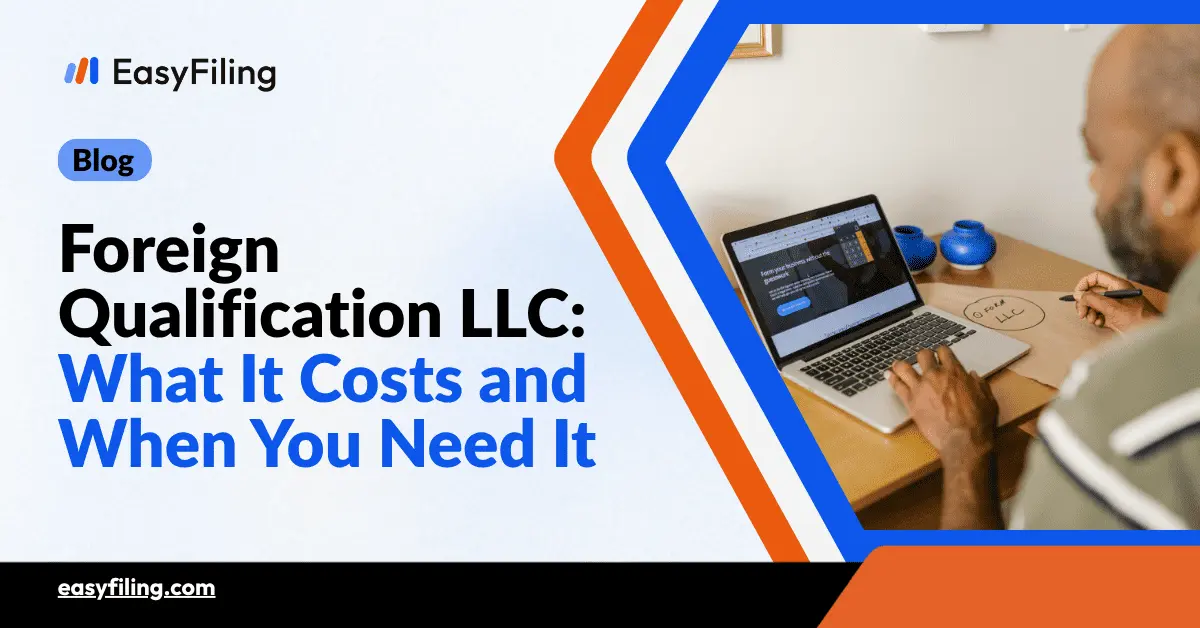
If you have registered your LLC or corporation in the state where it was formed but are doing business in another state, you will likely need to apply for foreign qualification LLC status in that state. Failing to do this means you risk losing the ability to litigate in its courts and accumulating back taxes and fines. The foreign qualification LLC application usually costs between $100 and $750 and can take anywhere from 0 days to 6 weeks to process.
What Foreign Qualification LLC Actually Means
A “foreign” LLC is not necessarily tied to international entrepreneurs, although many non-resident LLC owners in more than 175 countries ask about this. The term simply means that the company is incorporated in one state and operates in another.
For instance, if you start an LLC in Wyoming because of the favorable incorporation fees and lack of state income tax, and later on hire personnel in California, open a storage facility in Texas, or lease premises in New York, each of these states would consider your LLC to be conducting business there, triggering the need for a foreign qualification.
We have come across people who assume that incorporating in a business-friendly state like Delaware or Wyoming means they do not have to comply with other states’ requirements, which is incorrect. Your state of registration has little to do with the necessity of registering in states where you have actual business activity.
What Counts as “Doing Business” in a State
The confusion arises here for most founders because there is no unified federal definition, as each state sets its own threshold.
Some activities that initiate the foreign qualification process:
- Having an office, retail outlet, or storage facility
- Employing W-2 workers there
- Meeting clients regularly
- Owning or leasing property in that state
- Being in possession of the appropriate permits connected to a physical address
Activities NOT triggering qualification:
- Selling goods through an online store within the state
- Working with a contractor remotely in that state (this depends on the state, so local laws must be checked)
- Having an account
- Owning the shares or membership in any firm registered in that state
California has the most stringent requirements in this regard. It is known that the Franchise Tax Board initiated many audits of LLCs that were not doing business in the state but had a manager who attended a few meetings.
Cost Breakdown by State (as of July 2026)
Filing fees vary widely and change periodically, so always verify with the Secretary of State before filing.
| Texas | $750 | Certificate of Authority; one of the highest in the country |
| California | $70 | Plus mandatory $800 annual franchise tax, regardless of income |
| New York | $250 | Plus a publication requirement adding $500 to $1,500, depending on the county |
| Delaware | $200 | Certificate of Registration |
| Florida | $125 | — |
| Nevada | $75 | Plus a $200 state business license fee |
| Wyoming | $100 | — |
Most states also require a Certificate of Good Standing (sometimes called a Certificate of Existence) from your home state, issued within the last 30 to 90 days, depending on the receiving state’s rules. That certificate itself usually costs $10 to $50 from your state of formation.
The Filing Process, Step by Step
- Confirm your need to qualify. Check the specific “doing business” statute of the state or contact the Secretary of State’s business office. Don’t trust generic online guides, as thresholds vary.
- Obtain a Certificate of Good Standing from your home state. This shows that your LLC is up to date on its filings and fees. This process can take 1 to 5 business days or less if your state provides online ordering.
- Check the availability of the name in your new state. If your LLC has the same name, you will need to register it as an assumed name (DBA). This is usually the case with popular LLC names.
- Appoint a registered agent in the new state. You cannot rely on your agent back home. Each state in which you are qualifying needs its own registered agent with a physical address in that state.
- Submit the Certificate of Authority (or Application for Registration, depending on the terminology in your state) and the Certificate of Good Standing.
- Wait for approval. Nevada and Wyoming generally take 1 to 3 business days to complete their procedures. New York and California may take 3 to 6 weeks during the prime filing period, which runs from January to April, but it could take longer if any documents are not identical.
- You may also register for state tax accounts, where applicable, such as a sales tax permit, an employer withholding account, and unemployment insurance, based on your business activities.
Common Mistakes Founders Make
The same mistakes keep occurring repeatedly.
Waiting until a lawsuit or audit forces the issue. States can retroactively assess penalties and back fees once they discover unregistered activity, sometimes going back years. California, in particular, will deny you the right to bring a lawsuit in state court until you’ve registered and paid back franchise taxes, which can freeze a collections case mid-litigation.
Assuming online sales alone create a nexus. Under most state LLC statutes (separate from sales tax economic nexus rules), simply shipping products to customers in a state doesn’t require foreign qualification. Founders often over-register out of caution and end up paying annual report fees in states they don’t need to be in.
Forgetting annual compliance in the new state. Foreign qualification isn’t a one-time filing. Most states require an annual or biennial report, and missing it can lead to administrative revocation of your authority to do business there, plus separate late fees on top of your home state’s requirements.
Failing to change the registered agent once it expires. In case your registered agent resigns, or the state is unable to contact them, the state may revoke your foreign qualification with little notice. We have dealt with urgent cases of founders who learned that their New York authority had expired only because a bank raised a flag during the loan request.
Confusing foreign qualification with the process of registering a new LLC. The two forms are totally different and require separate tax IDs. Foreign qualification involves entering another state with an already existing LLC, so it does not create a separate legal entity.
Does Foreign Qualification Change Your Tax Obligations?
Yes, and this is a point that triggers numerous misunderstandings. The concept of foreign qualification applies to state laws rather than federal laws. The employer identification number and federal taxation status do not change when you apply for foreign qualification.
After being approved for foreign qualification in a new state, you must pay the income, franchise, or gross receipts tax of that state according to the income you earn in that state. For instance, the California minimum annual franchise tax of $800 is imposed even if your company incurs losses in a given tax year. The state of Florida has the biggest difference: it has no personal income tax but imposes a franchise tax when a firm’s revenue exceeds a government-set threshold.
If you are a founder who does not live in the state where your company operates, we highly recommend hiring a CPA who specializes in multistate taxation.
Getting Foreign Qualification Handled Correctly
If you are moving operations into a new state, even if it means recruiting your first local employee or opening a physical business location, it is advisable to secure your foreign qualification before the foreign activity occurs. EasyFiling can assist with Certificate of Authority filings, registered agent services, and Certificate of Good Standing requests across all 50 states and will inform you if your specific activity requires foreign qualification so you don’t incur unnecessary expenses.
“This content is for informational purposes only and does not constitute legal, tax, or financial advice. For advice specific to your situation, consult a qualified US attorney or CPA.”
File Your LLC Today
25$ off with a coupon
Lock in EasyFiling's transparent rates and get lifetime compliance support at no extra cost.
Get Started Now
Swostika Silwal