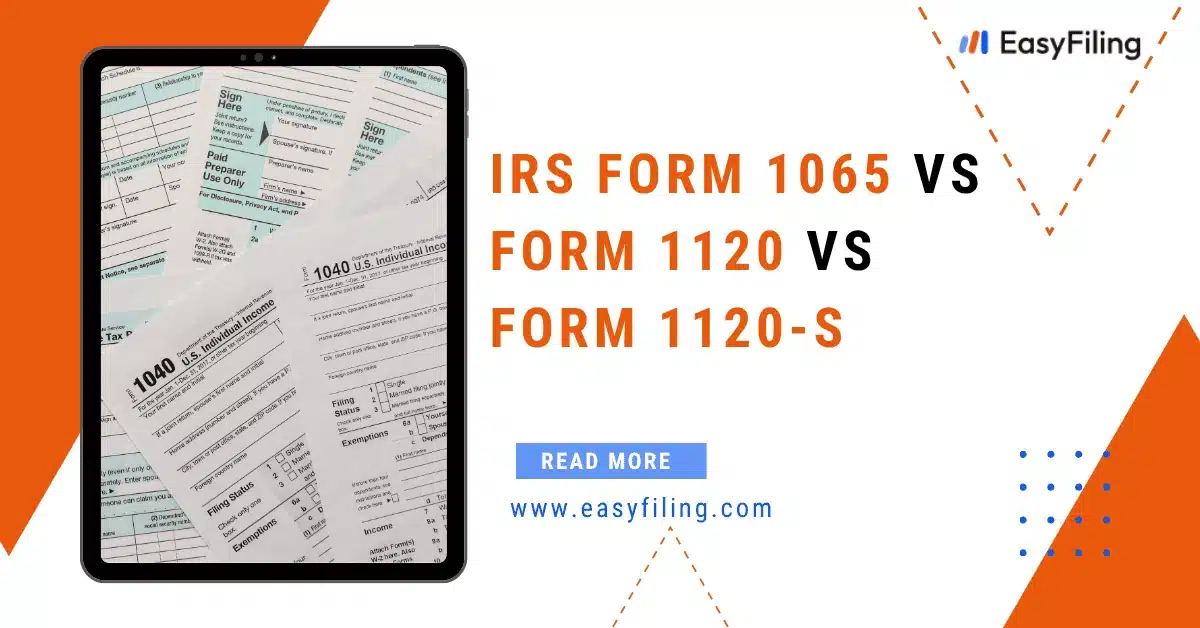
Form 1065 is for partnerships and multi-member LLCs. Form 1120 is for C corporations. Form 1120-S is for S corporations. The right form depends on how your entity is classified with the IRS, not just what you registered at the state level.
The question comes up constantly: “My LLC is filing taxes for the first time. Which return do I use?” The answer is not always obvious, and the confusion is understandable. IRS Forms 1065, 1120, and 1120-S cover three different tax structures, and choosing the wrong one can trigger penalties, amended returns, and, in some cases, IRS notices that take months to resolve.
Here is what actually determines which form you file.
What Entity Type and Tax Classification Actually Mean
Your state registration and your IRS tax classification are two separate things. You can form an LLC in Delaware and have it taxed as a C corporation, an S corporation, or a partnership. The state does not decide this. The IRS does, based on elections you make (or do not make).
A single-member LLC is disregarded by default. It files on Schedule C of the owner’s personal return unless the owner elects corporate taxation using Form 8832 or Form 2553.
A multi-member LLC is treated as a partnership by default. It files Form 1065. If the members want S corp or C corp treatment, they need to file an election form with the IRS first.
Corporations are C corps by default and file Form 1120. If eligible, they can elect S corp status by filing Form 2553 and Form 1120-S instead.
Form 1065: The Partnership Return
Form 1065 is an informational return. The partnership itself does not pay federal income tax at the entity level. Instead, income, deductions, and credits pass through to each partner via Schedule K-1, which each partner then reports on their individual return.
Who files it: Multi-member LLCs (default classification), general partnerships, limited partnerships, and LLPs.
Due date: March 15 for calendar-year filers. Extensions are available via Form 7004, which provides an additional 6 months, moving the deadline to September 15.
Filing fees: The IRS charges no fee to file Form 1065. However, some states impose a separate partnership return fee or franchise tax. California, for example, charges LLCs a $800 minimum franchise tax plus an additional fee based on gross receipts, regardless of whether the entity is profitable.
Common mistake: Founders with multi-member LLCs assume they can file a Schedule C because they split income 50/50. That is not how it works. Two or more members mean a partnership return is required unless an election was made to be taxed otherwise.
For non-resident founders: Foreign partners receiving income through a U.S. partnership are subject to withholding under FIRPTA or Section 1446. The partnership must withhold and remit tax on behalf of foreign partners, which adds compliance obligations many founders do not expect.
Form 1120: The C Corporation Return
Form 1120 is the federal income tax return for C corporations. Unlike partnerships and S corporations, C corporations pay corporate income tax directly. Profits distributed as dividends are then taxed again at the shareholder level, which is the double taxation issue most founders have heard about.
Who files it: Corporations that have not elected S corp status, and any LLC that elected C corp taxation via Form 8832.
Current corporate tax rate: A flat 21% as of June 2025, following the Tax Cuts and Jobs Act.
Due date: April 15 for calendar-year filers. The extension deadline via Form 7004 is October 15.
Why some founders choose C corp taxation: Venture-backed startups, companies planning to issue multiple stock classes, and businesses with foreign shareholders often operate as C corps. S corporations have strict eligibility requirements that C corporations do not. Foreign owners, for instance, cannot hold shares in an S corp, which eliminates that option for most non-resident founders.
Common mistake: Founders who raise a small angel round and keep their LLC structure sometimes elect C corp taxation, assuming it makes them look more legitimate to investors. That is not a sufficient reason to take on the added complexity of Form 1120. Talk through the tradeoffs before making that election.
Form 1120-S: The S Corporation Return
Form 1120-S is the return for S corporations. Like partnerships, S corporations are pass-through entities. The company files an informational return and issues K-1s to shareholders. No corporate-level income tax applies (with limited exceptions in certain states).
Who files it: Corporations that have filed and been approved for S corporation election via Form 2553. Some LLCs also elect S corporation taxation.
Due date: March 15 for calendar-year filers. Extensions via Form 7004 push the deadline to September 15.
Eligibility requirements: S corporations can have no more than 100 shareholders. All shareholders must be U.S. citizens or permanent residents. Only one class of stock is permitted. These restrictions make the S corporation structure largely unavailable to international founders.
Common mistake: Missing the S corp election deadline. Form 2553 must generally be filed within two months and 15 days of the beginning of the tax year in which the election is to take effect. Miss that window and you are looking at a full year wait, or a request for late election relief, which is not guaranteed.
Side-by-Side Comparison (Form 1065 vs 1120 vs 1120-S)
| Form 1065 | Form 1120 | Form 1120-S | |
| Entity type | Partnership / multi-member LLC | C corporation | S corporation |
| Tax level | Pass-through | Entity-level (21%) | Pass-through |
| Due date | March 15 | April 15 | March 15 |
| Extension deadline | September 15 | October 15 | September 15 |
| Foreign owners allowed | Yes | Yes | No |
| Stock classes | N/A | Multiple | One only |
| Max shareholders | Unlimited | Unlimited | 100 |
How to Know Which Form You Should Be Filing
Start with your IRS entity classification, not your state registration. If you are unsure of your classification, pull your EIN confirmation letter (CP 575 or 147C). It will show how the IRS has classified your entity.
If you made an election using Form 8832 or Form 2553, those elections define your filing requirement. If you never filed either form, default rules apply based on your entity structure.
If you have been filing the wrong return, do not ignore it. Amended returns can be filed, and in many cases, the IRS will work with you if the error is caught early and there is a reasonable explanation.
We work with founders across 175+ countries who are filing U.S. returns for the first time. The most common issue we see is a multi-member LLC that assumed it could skip a partnership return because the business made no profit. The IRS still requires Form 1065 to be filed, even for a zero-income year.
FAQ for Form 1065 vs 1120 vs 1120-S
Can a single-member LLC file Form 1065?
No. Form 1065 is for entities with two or more partners or members. A single-member LLC is disregarded by default and reports income on the owner’s personal return. The exception is if the single-member LLC has elected corporate taxation via Form 8832.
What happens if I file the wrong tax return?
The IRS may send a notice requiring you to refile using the correct form. Penalties can apply for late or incorrect filings. In some cases, you can file an amended return to correct the error without major consequences, but acting quickly matters.
Can a foreign-owned LLC file Form 1120-S?
No. S corp status is available only to entities with U.S. citizens or permanent residents as shareholders. A foreign-owned LLC cannot elect S corp status. The options are default partnership taxation (Form 1065), disregarded entity treatment if single-member, or C corp taxation (Form 1120).
What is the penalty for filing Form 1065 late?
The IRS charges $235 per partner per month for late partnership returns, with a maximum of 12 months. For a two-member LLC that files three months late, that is $1,410 in penalties. The penalty has increased in recent years and is not trivial.
Do I need an EIN to file any of these returns?
Yes. All three returns require an Employer Identification Number. If your entity does not yet have one, that needs to be resolved before you can file.
Not sure which return your business needs? We handle EIN registration, entity classification, and annual compliance filings for U.S. businesses owned by founders in 175+ countries. If you need help confirming your IRS classification or getting your federal return filed correctly, get in touch with our team at EasyFiling.
“This content is for informational purposes only and does not constitute legal, tax, or financial advice. For advice specific to your situation, consult a qualified US attorney or CPA.”
File Your LLC Today
25$ off with a coupon
Lock in EasyFiling's transparent rates and get lifetime compliance support at no extra cost.
Get Started Now
Swostika Silwal