Multi-state payroll kicks in the moment an employee works from a state other than the one where your LLC was formed. You need to document withholding and unemployment taxes in the state where the employee works, often the same state where your LLC is registered, and then run payroll in accordance with that state’s rules. Federal payroll tax rules are the same everywhere, but state rules, accounts, rates, and deadlines vary.
Multi-state payroll happens to founders earlier than expected. A Lagos-based founder starts a Wyoming LLC, hires a bookkeeper in Texas, a developer in California, and a support representative in New York. All this happens in the company’s second year.
This is what we see on the LLC formation side. Founders in the 175+ countries we serve plan their LLC, EIN, and banking carefully, then assume a payroll app will handle the rest. Payroll apps can calculate and file for the tax accounts you provide, but they cannot create those accounts.
Below, we break down how multi-state payroll works in the U.S., the associated costs as of November 2026, the process, and the most common mistakes.
When does multi-state payroll actually start?
Multi-state payroll starts the moment an employee works in a different state than the one your LLC was formed in, not the state your customers are in, not the state your registered agent is in, etc.
One home-based Oregon employee is the limit. Withholding is taken from that employee’s wages by the state of Oregon. Oregon unemployment insurance also applies. Other states usually don’t provide any grace period.
With an unemployment tax, the state where the work is localized usually wins. If an employee works in both states, it depends on the location of the employer’s base of operations and the employee’s residence. Remote employees working in only one state are simple. Remote employees working in two or more states are the ones we have to slow down and check.
True independent contractors and workers outside the U.S. who are not U.S. citizens or residents are two groups of employees that are completely outside the scope of this. True independent contractors are paid with a 1099-NEC, and the employment laws of other countries may apply.
Should a non-resident founder be on the payroll?
Generally not, and this surprises people. If you own a single-member LLC, you are not an employee. Multi-member LLCs are the same. With a partnership, guaranteed payment replaces a salary.
From a tax perspective, salary only comes into play with C Corporations. This is because only C Corporations can pay out salaries to their shareholders. An LLC can also elect to have its business taxed as a C Corporation. Being an S Corporation is not an option for shareholders who are nonresident aliens, which is the case for most of the founders we work with.
The first thing to think about is not which states you will hire in. It is: Will you take a salary? This will impact the type of entity you form before your first hire. Forming a C Corporation means you’ll need to think through payroll and employee taxes. This also means paperwork in every state where you are registered if you ever decide to switch from a C Corporation to an LLC.
Founders who have a disregarded LLC and only pay a team can skip this. Payroll is always for the people you hire, not you.
What has to be in place before the first paycheck?
Three things, in this order.
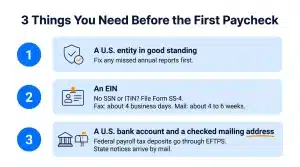
A U.S. entity in good standing. Most state tax agencies check. Fix an LLC that missed its annual report, starting with the formation state. If you have not formed yet, starting a US LLC is the next best step, and the state of formation matters less for payroll than most founders assume. The work state determines most of the rules.
An EIN. Every payroll account asks for it. Non-resident founders who do not have an SSN or ITIN can’t use the IRS online application, which requires a responsible party with either an SSN or an ITIN. They file Form SS-4 by fax or mail. Fax comes back in about four business days, and mail takes about four to six weeks. Getting an EIN online works if the responsible party qualifies. If they do not, we file the SS-4 on their behalf.
A U.S. bank account and a verified physical address. Federal payroll tax deposits go through EFTPS. A U.S. bank account should be set up before hiring. Notification letters, including penalty letters, from State agencies are sent by mail. A virtual address works if the scans are checked every week.
What does multi-state payroll cost?
Payroll tax has a federal layer that never changes by state and a state layer that changes constantly.
Payroll tax rates, as of November 2026
FUTA usually comes out to around $42 per employee per year. The SUTA is where the costs of a multi-state payroll may diverge.
Florida, California, Tennessee, Arkansas, and Louisiana use a $7,000 base. Washington’s base in 2026 is $78,200. At a hypothetical 2% rate on a $60,000 salary, unemployment tax is around $140 in Florida and $1,200 in Washington. Same salary, same job title. Your actual rate will vary by state and by industry. New employers will receive a rate notice from the state agency after they register.
One cost founders often overlook is registering the LLC in that state. When an employee works in a state, that state often considers your LLC to be doing business there, which may require foreign qualification.
Foreign LLC registration, as of November 2026
State fees only. New York publication costs vary by county and are set by the newspapers, often ranging from hundreds to thousands of dollars. Miss the 120-day publication deadline and the LLC’s authorization is automatically revoked in New York. Check with the SOS office for fee changes.
How do remote employees, reciprocity, and the convenience rule affect withholding?
Withholding generally follows the state where the work is performed. The convenience of the employer rule, along with the reciprocity agreement, is the exception to this general rule.
Let’s first discuss the convenience of the employer rule. New York, Pennsylvania, Delaware, and Connecticut can tax a remote employee’s wages as if the employee were working in the employer’s office in the state. To qualify under this rule, the employer must require remote work for a legitimate business reason. Nebraska has a rule similar to those of the above-mentioned states, which went into effect in 2025.
Now, let’s discuss reciprocity. Some neighboring states have an agreement under which an employee working in the other state is considered a resident of that state for income tax purposes. These agreements do not affect the employer’s withholding. You, as the employer, are still required to withhold for the work state and register for unemployment insurance in the work state. Pennsylvania has reciprocity agreements with Indiana, Maryland, New Jersey, Ohio, Virginia, and West Virginia. Illinois has reciprocity agreements with Iowa, Kentucky, Michigan, and Wisconsin. The employer is required to file an exemption certificate to avoid withholding in that state.
The trigger is where your LLC has an office. Remote-first LLCs with a registered agent address and no office in the state are mostly outside the rule. A manager or a rented desk in NY may subject someone working from home in Georgia to NY tax. Your best evidence is your written remote work policy.
Which states give founders the most trouble?
California
California. The EDD runs withholding, UI, and State Disability Insurance through the same account. Employers have to register to pay within 15 days of paying more than $100 in a quarter. The LLC is registered, and the $800 minimum franchise tax applies. Founders who just budgeted for payroll may be caught off guard. CA also uses the ABC test to determine employment status for contractors, so a freelancer paid on a 1099 may be considered an employee under that test.
New York
New York. Employers are required to carry disability and paid family leave coverage, usually through an insurer. Adding the publication requirement and setting up an NY hire is the longest of all the states we see.
Washington
Washington. The state has the highest unemployment wage base in the nation, PFML, and workers’ comp through the state fund. WA, OH, ND, and WY don’t allow most employers to buy private workers’ comp insurance, so your typical broker policy won’t protect you there.
Texas and Florida
Texas and Florida have no state income tax on wages. As a result, no withholding accounts are needed. Unemployment taxes and registration with the Texas Workforce Commission or Florida’s Reemployment Tax System still apply. “No income tax” is often read as “no payroll registration.” This is confusing and wrong.
Pennsylvania and Ohio
Pennsylvania and Ohio have Local Earned Income taxes stacked on top of State Withholding. Each municipality has its own collector. You may need to register with the correct collector for both the employee’s home and work locations.
How do you add a new state? Step-by-step guide
- Confirm where the employee will actually work. The home address and expected work days should be documented before the offer letter is issued.
- See if your LLC needs to register in that state. If it does, you should first appoint a registered agent in that state, since the state requires a local address for service of legal notices. A registered agent service is always included in the foreign qualification filing in the states where it is needed.
- State Withholding. Follow state requirements for withholding. Skip if the state doesn’t have a wage income tax.
- State Unemployment Insurance. Follow your state’s unemployment insurance requirements and save your rate notice.
- Workers’ Compensation and Disability Insurance/Paid Leave. Follow state requirements for workers’ compensation insurance, state temporary disability insurance, and paid family leave programs.
- State Tax IDs. Add the state IDs to your payroll provider and confirm that the payroll provider files in the state, not just calculates.
- New Hire Reporting. Report the new hire to the state directory. Federal law requires you to do this within 20 days of the new hire date. Some states have a shorter timeframe.
- Compliance Calendar. Add the state’s quarter dates to your compliance calendar.
Schedule. Begin 4-6 weeks from the start date. State registration is usually not the long pole in the tent. Foreign qualifying and workers’ compensation quotes usually are. Texas usually takes a week. California usually takes several weeks unless you pay for expedited processing.
Which payroll deadlines apply once you have employees in several states?
The federal dates are fixed. The state dates are the ones that slip because each state assigns its own filing frequency when you register. Write down what each state assigned you on the day the notice arrives.
What mistakes do founders make with multi-state payroll?
Registering after the first paycheck. State agencies will often back-assess penalties and interest, and the notices may arrive months later, by which time no one remembers the details.
Withholding for the formation state instead of the work state. A Delaware LLC with an employee in Colorado will withhold for Colorado. Delaware registration doesn’t change that.
Treating a no-income-tax state as a no-registration state. Unemployment tax and new hires still apply.
Ignoring a mid-year move. For a new employee location, withholding and unemployment reports need to be changed. Ask for a state withholding form if an employee mentions a new location.
Misclassifying employees as contractors. Full-time remote developers paid with invoices work until the employee files for unemployment. California makes this even riskier with the ABC test.
Mixing owner draws and wages. Owner draws are recorded in equity, but if they’re recorded in payroll, the 941 balance won’t match the books, and no one will know why. Bookkeeping reconciliation of the 941 to the books will catch this.
Letting foreign registrations lapse. Texas can charge a $750 assessment for each year an entity did business without registration. Each state has its own annual report or tax. The key to staying compliant is to do the annual reports.
Should you use a payroll provider or an employer of record?
A payroll provider is a good option for employers with employees in a few states, as it charges a fee to file state returns. You set up the LLC, open the state accounts, and the provider runs the payroll and files the returns. Confirm the provider files returns for all states where you hire employees, because some only calculate state returns.
An employer of record hires the employee in its own name, so your LLC doesn’t have to register in that state at all. This makes sense for 1 or 2 employees in a state like New York, where the state registration is lengthy and costly. This is no longer the case if you have multiple employees in the state.
As a general rule, if you think you’ll keep a team in a state for more than a year, register the LLC and run payroll yourself. If it’s a short-term contract, use an employer of record.
How does payroll fit with the rest of your U.S. compliance?
Payroll touches almost every other filing your LLC has, and founders often get caught up in filing these connectors.
The first are the annual reports. Every state where your LLC is registered expects its own annual report or franchise tax on its own schedule. Make sure to add these along with payroll accounts.
Second, tax filings. Foreign-owned single-member LLCs file Form 5472 with a pro forma Form 1120, regardless of payroll. Payroll adds a quarterly 941, an annual 940, and W-2s. So a US tax filing for a foreign-owned LLC with U.S. employees is a much larger workload than for a foreign-owned LLC with no U.S. employees.
Third, ownership reporting. As of November 2026, the filing of a beneficial ownership information (BOI) Form with the U.S. Internal Revenue Service (IRS) will no longer be required for Limited Liability Companies (LLCs) formed in the U.S. This final rule, which FinCEN issued on August 11, 2026, will permanently exempt domestic companies. Foreign companies registered in the U.S. remain subject to this final rule.
Lastly, terminating a state. Layoffs do not automatically close payroll accounts. You file final returns and close payroll accounts. Additionally, you may need to withdraw your LLC’s registration from that state or maintain it. Leaving payroll accounts open quickly complicates a company dissolution because the state expects continued filings.
Looking to hire in a new state? First, perform a compliance check.
Before extending an offer letter, send us your LLC’s state of formation, the potential employee’s home state, and whether the employee will be a fixed-location employee. We will tell you whether your LLC must register to do business in that state, approximately how much the filing will cost, how long it will take, whether payroll accounts will be triggered, and where. You will have this information before you extend an offer letter.
Frequently Asked Questions About Multi-State Payroll
Do I need to register my LLC in every state where an employee works?
Most States say that an employee working in that State means your LLC is doing business in that State, thereby requiring foreign qualification. Fees typically range from $70 to $750, and some states also charge an annual tax. A few States have exceptions to the rule, but typically you can assume your LLC is not exempt. Check with the Secretary of State’s Office to be certain.
How many employees do I need to have multi-state payroll?
Just 1 employee. Having an employee work in a different State from your LLC’s home State requires you to register with that State to withhold and pay unemployment taxes. There is no exception for having a certain number of employees.
Are there payroll providers that can handle all 50 States?
Most payroll providers say they can do all 50 States, but you still have to set up the accounts with the States first. Some do the setup for you for an additional fee. Before you retain their services, make sure they can do the States that you need.
Do owner draws go through payroll?
No. Owner draws for a single-member or partnership-taxed LLC are not wages. They go through equity on your books. Owners of a C-corporation or an LLC taxed as a corporation take a salary through payroll.
What happens if an employee moves to another state mid-year?
Starting from the date of the move, withholding and reporting of unemployment compensation will change to the new state. Register in the new state before your next payroll, update the employee’s state withholding form, and continue filing returns for the old state until you complete the move.
Do reciprocity agreements eliminate the need to register?
No. Reciprocity alters which state gets the withholding for income taxes. You still have to register for unemployment compensation in the state where the employee works.
Related guides
“This content is for informational purposes only and does not constitute legal, tax, or financial advice. For advice specific to your situation, consult a qualified US attorney or CPA.”
File Your LLC Today
25$ off with a coupon
Lock in EasyFiling's transparent rates and get lifetime compliance support at no extra cost.
Get Started Now
Swostika Silwal