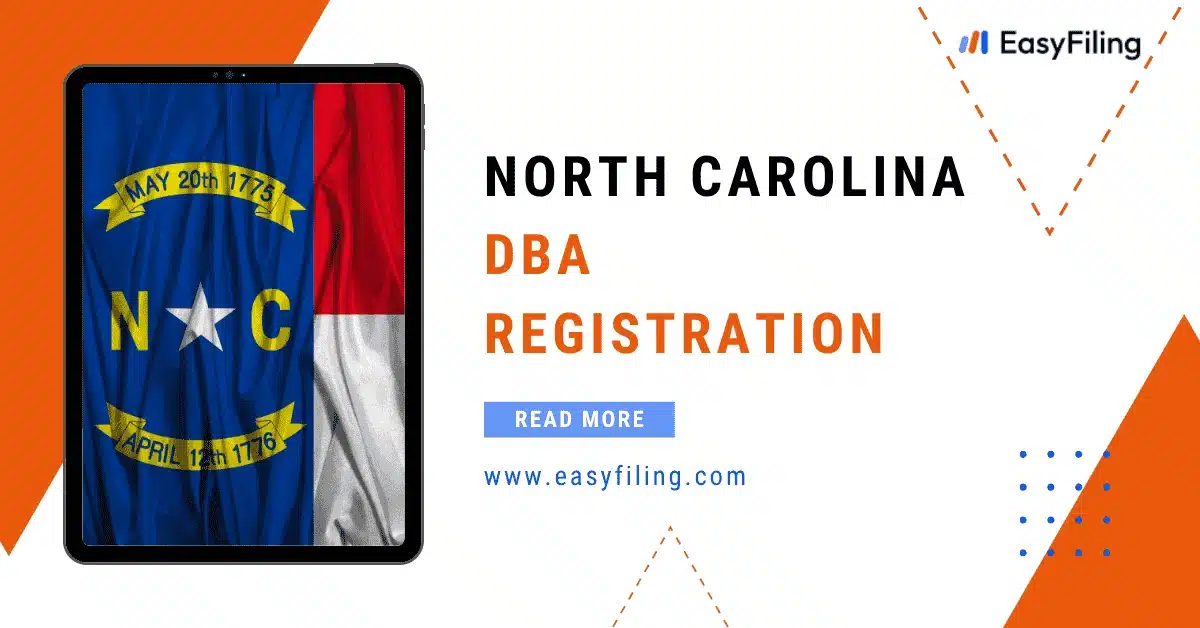
Registering a DBA (Doing Business As) in North Carolina is the first legal step if you want to conduct business using a name other than your legal name. North Carolina General Statutes, Chapter 66, Article 14A, require all individuals and business entities that operate under an assumed or trade name to register with the Register of Deeds in the county where the business is physically located. This guide explains everything that sole proprietors, LLCs, and corporations need to know to register and remain compliant in 2026.
What is a DBA in North Carolina?
DBA means “Doing Business As.” In North Carolina, this name is an Assumed Name or Trade Name, all of which refer to the name you need to register in order to conduct business using a name that is different from your legal name.
For example, a sole proprietor named Marcus Allen cannot use the name “Coastal Blueprint Design” to conduct business unless he registers a DBA in North Carolina. If he does not register a DBA, he will not be able to open a business bank account to deposit his business earnings, issue invoices for payment, or enter into legally binding contracts.
A DBA is not a business structure. It does not provide personal liability protection, create a new EIN, or serve as a name trademark; it is simply a name registration and is legally and practically necessary.
Who Needs North Carolina DBA Filings in 2026?
| Entity Type | When a DBA Is Required |
|---|---|
| Sole Proprietor | Any name other than your full legal name |
| General Partnership | Any name other than the names of the partners |
| LLC | Any name other than the LLC registered name |
| Corporation | Any name other than the name of the Corporation |
| Foreign Entity | Any name under which an out-of-state business operates in NC |
| Nonprofit | Any name other than the name of the nonprofit |
There are no new exemptions for any entity type. These requirements remain fully in effect in 2026.
Where to File
All entities, including sole proprietors, partnerships, LLCs, corporations, and foreign entities, file an Assumed Business Name Certificate with the Register of Deeds in the county of business operation. There is no separate filing track with the Secretary of State for LLCs and Corporations. The Secretary of State maintains only an electronic database of county-level business name registrations.
Since December 1, 2017, a single registration may cover one, some, or all 100 counties for no additional fee. If you do business in many countries, you will not have to register in each one separately.
How to Complete Your North Carolina DBA Registration Step by Step
Step 1 — Pick a Compliant Trade Name
NC naming rules must be followed. Your trade name cannot be identical to or deceptively similar to a name already registered. Trade names cannot have restricted terms such as “Bank,” “Insurance,” or “University,” etc. Restricted terms may be used only with proper authorization. Lastly, trade names cannot mislead the public.
Step 2 — Check the Name Availability
You must check name availability with the sources listed below before making a filing:
- NC Secretary of State Business Search: sosnc.gov
- Your county’s Register of Deeds for local assumed name filings
- USPTO Trademark Database
- Social Media Platforms and Domain Names
Step 3 — Complete and Submit Your Application
In order to complete the filing process, a certificate of assumed business name must be submitted to the Register of Deeds in the county where you plan to conduct business. This process is the same for sole proprietorships, partnerships, LLCs, and corporations. If you wish to have the certificate cover multiple counties, you must list them on a single certificate. Most offices accept filings in person and by mail. Some offices also provide e-recording services through a vendor at a fee.
Step 4 — Submit Payment for the Filing Fee
The fee for recording is set by law at $26 for up to the first 15 pages and at $4 for each subsequent page. Since most certificates are on a single page, the cost will be $26, regardless of the type or the number of entities. If e-recording is used, a vendor convenience fee will be assessed.
Step 5 — Save Your Certificate
After your certificate is approved, you will need both a hard and an electronic copy of your Assumed Name Certificate. This is required to open a bank account, obtain licenses, and/or validate your trade name with vendors and clients.
Estimated Processing Times for 2026
| Filing Method | Estimated Time |
|---|---|
| Go in person to the county Register of Deeds | Same day for most counties |
| Mail to the County Register of Deeds | 1 business day plus transit time |
| Available e-recording | Similar to in-person, plus a vendor fee |
Assumed name filings will not be expedited, so plan accordingly.
After Approval: What to Do Next
With your North Carolina DBA registration, you can now:
- Use your DBA certificate to open your first business bank account
- Change all contracts, invoices, and marketing materials to reflect your business name
- Inform all clients and vendors of the new business name
- Update your business insurance policy to verify coverage for the name
- Consider filing for a federal trademark with the USPTO to protect your business name nationally
DBA vs. LLC in North Carolina (2026 Comparison)
| Feature | DBA | LLC |
|---|---|---|
| Separate legal entity | No | Yes |
| Personal liability protection | None | Yes |
| Filing Fee | $26 | $125 |
| Statewide Name Exclusivity | No | Yes |
| Annual Reporting | No | Yes |
| Taxation | No Change | Flexible (S-Corp option) |
| Best for | Brand Name Use | Full Legal Protection |
DBAs are good for low-cost trade names. An LLC is for business owners wanting to protect their personal assets.
Managing Your North Carolina DBA in 2026
Renewals: There are no renewal deadlines. If you file your DBA, it remains active until it is withdrawn.
Amendments: If you changed your legal name, business address, or trade name, you have 60 days to file a certificate of amendment with the same county Register of Deeds.
Cancellations: If you no longer use a trade name, file a certificate of withdrawal to maintain an accurate public record.
Multiple DBAs: There is no legal limit to the number of DBAs you can have. It is also free to add more counties to one certificate. However, you must file for each distinct name individually and pay the fee for each.
2026 Key Legal Facts at a Glance
- A DBA is not personal liability protection
- A DBA is not a business name trademark
- A DBA does not necessitate a new EIN
- You may use your DBA name to sign contracts, but your legal entity name must also be included
- Other businesses in your county may use the name registered with you. Only the names of LLCs and corporations registered with the Secretary of State carry naming exclusivity.
Frequently Asked Questions
Is North Carolina DBA registration legally required?
Yes. It is required, as mandated by NC General Statutes Chapter 66, Article 14A, for the registration of any assumed name used in business.
How much does it cost in 2026?
It will cost about $26, the same amount regardless of how many counties you list.
Do I need to renew my DBA?
No. There is no renewal deadline under current law.
Can I bank with a DBA?
Yes. You can use your DBA as the business name on a bank account.
Do I have asset protection with a DBA?
No. You will have to form an LLC or corporation to have personal liability protection.
File Your North Carolina DBA with EasyFiling
Because EasyFiling eliminates the tedious steps associated with North Carolina DBA registration, you can better spend your time managing your business. Our experts take care of everything for you, from the name check to registration to the final submission.
Final Thoughts
Registering for a DBA in North Carolina in 2026 makes sure you stay within the required laws regarding naming your business, makes business banking available, and gives your brand name official recognition. If you file correctly, your trade name gives you a solid name for all future business activities.
“This content is for informational purposes only and does not constitute legal, tax, or financial advice. For advice specific to your situation, consult a qualified US attorney or CPA.”
File Your LLC Today
25$ off with a coupon
Lock in EasyFiling's transparent rates and get lifetime compliance support at no extra cost.
Get Started Now
Swostika Silwal