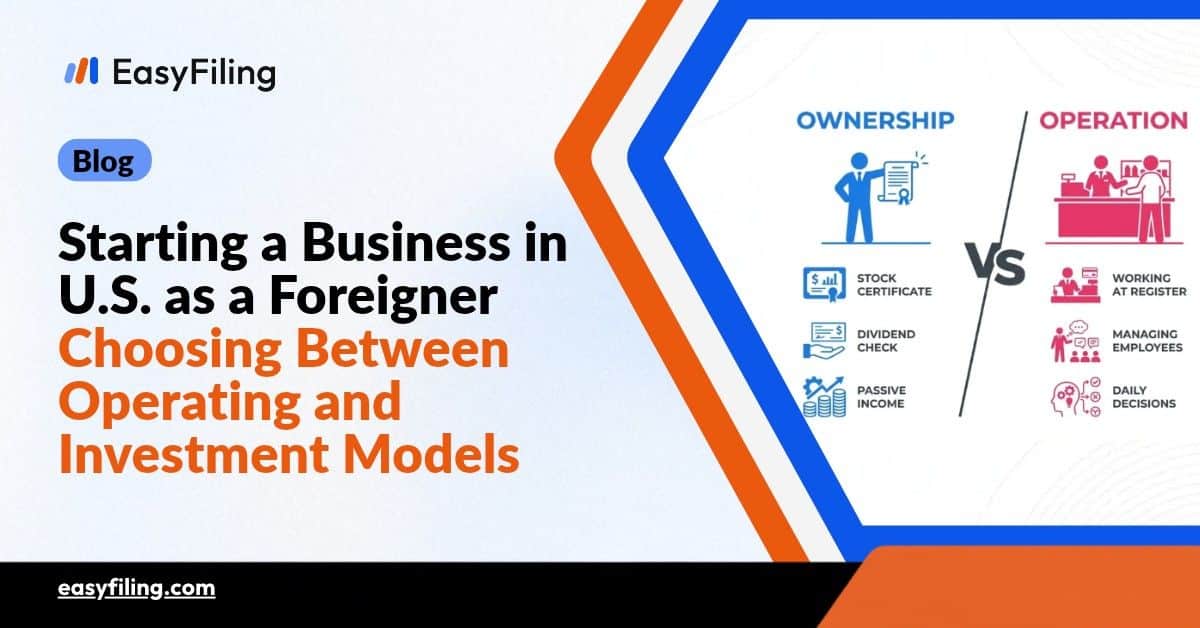
Picture two foreign entrepreneurs putting $500,000 each into a U.S. business. One moves to Austin and throws herself into running the company, hiring people, negotiating deals, and dealing with whatever goes wrong before lunch. The other stays in São Paulo. He hires people to run the business, checks in on the numbers every few months, and gets involved when a big decision comes up.
Same country. Same amount of money. Two very different ways of doing business. And the choice between them matters long before either entrepreneur signs the first contract.
Forming a U.S. company is the easy part. The harder question is what you’re actually allowed to do with it, and what that means for your visa, taxes, and business setup. Foreign entrepreneurs face an important choice early on: run the business themselves or invest in one managed by someone else. Both paths are possible, but they come with different requirements. And choosing the wrong structure at the start can be painfully expensive to fix later.
The Foundational Distinction: Owning vs. Operating
Ownership is open to (almost) everyone
Here’s the part that surprises people. No U.S. citizenship, residency, or visa is required to own a U.S. LLC or corporation. Formation can be done entirely remotely. A foreign national can be the sole owner, full stop.
But ownership ≠ work authorization
And here’s the part that gets people in trouble. Owning a U.S. company doesn’t give you permission to live or work in the country. Getting paid is a separate question. It depends on what you’re doing, where you’re doing it, and what your immigration status allows. Visitor status – B-1 or ESTA – permits a narrow band of activities: meetings, negotiations, signing contracts. Day-to-day management and productive work are not in that band. Cross the line, and you risk visa denials, entry bans, and jeopardy to the very business you were trying to build.
The two models defined
So the fork. Operating model: you run the business yourself. If you’re doing that work in the U.S., you’ll generally need the right immigration status and work authorization. Investment model: you own a stake while someone else handles the daily operations. And here’s the detail people miss: where you actually do the work matters just as much as the role you take. Everything downstream – entity choice, visa, taxes, banking – flows from this single decision. Choose it first.
The Operating Model: Running the Business Yourself
Who it fits
Founders relocating to the U.S. Owners expanding an existing foreign company into the market. Operators who want – genuinely want – control.
Visa pathways for operators
The menu is longer than most people expect:
- E-2 Treaty Investor: for nationals of treaty countries, requiring a “substantial” at-risk investment and proof you’ll “develop and direct” the business. E-2 status can be renewed as long as the business and investor continue to qualify. But it doesn’t turn into a green card on its own. That’s the trade.
- L-1 Intracompany Transferee: for owners of a foreign business opening a U.S. branch or subsidiary, requiring one year of prior employment with the foreign entity. New-office L-1s get a short initial runway to prove the business is real.
- O-1: for founders with demonstrated extraordinary ability. Increasingly popular among high-profile entrepreneurs, and increasingly contested.
- International Entrepreneur Parole: for startup founders with qualifying U.S. investor backing or government grants. Thresholds adjust periodically – verify the current figures before planning around them.
- EB-5 Direct: investing in a business that creates qualifying U.S. jobs, with a potential path to a green card if the program’s requirements are met. More on this under the investment model, since it straddles both worlds.
Entity choice for operators
An LLC offers flexibility, including pass-through taxation in many cases, but foreign owners may face U.S. tax filing obligations depending on how the business is structured and taxed. A C-corporation is the standard for venture-backed startups; it adds a corporate tax layer but cleanly separates you from the complexity of pass-through taxation. One more thing, and it needs saying loudly: where you actually operate matters far more than incorporation-state mythology. A Delaware LLC operating from Texas is, for most practical purposes, a Texas business wearing a Delaware hat.
Tax posture for operators
Running a business in the U.S. can generate effectively connected income (ECI), but the tax bill depends on how the company is structured and who’s receiving the income. Salary has its own rules. In general, where you physically do the work matters more than where the company was formed. A U.S. company doesn’t automatically make every paycheck U.S.-source income.
Then there’s the residency trap, and it constantly catches smart people. Spend enough days in the U.S., and the substantial presence test can make you a U.S. tax resident for purposes of worldwide income. Count your travel days. Deliberately. Tax treaties may soften double taxation, but the right structure depends entirely on your home country – which is why “my friend did it this way” is not a tax strategy.
The Investment Model: Owning Without Operating
Who it fits
Investors seeking U.S. market exposure. Families planning a move years down the road. Entrepreneurs are testing a market before committing to a relocation.
For some foreign investors, owning a U.S. business is only part of the picture. Commercial real estate offers another way to put capital to work without relocating or taking on day-to-day operations. But investing in U.S. commercial real estate from abroad comes with its own decisions: which market to enter, how to structure ownership, who will manage the property, and how to evaluate a deal from thousands of miles away. Getting those answers right matters just as much as choosing the asset itself.
Structures for passive ownership
Passive LLC membership or corporate shares – invest capital, appoint a manager or hire an executive, stay out of operations. Silent partnerships in existing U.S. businesses. Franchise investment with a hired management team – though a caution belongs here: many franchise agreements contractually require owner-operation. Verify before assuming passivity, because discovering that clause after signing is a miserable way to learn contract law.
The EB-5 regional center route
This is the investment route for people who want a possible path to a green card without running a business day-to-day. The required investment is currently $800,000 for qualifying targeted employment areas or infrastructure projects, and $1,050,000 for all other cases. Those figures are scheduled for an inflation adjustment in 2027, so check them before making plans. The project must meet the program’s job-creation requirements, generally at least 10 qualifying full-time jobs per investor. Regional center projects can count certain indirect jobs, which is part of their appeal. But the investment alone doesn’t guarantee permanent residency. The project, the paperwork, and the investor all have to qualify. For families, that’s a distinction worth understanding before the money moves.
Tax posture for passive investors
Dividends and certain other types of U.S.-source passive income can face 30% withholding. But not every payment gets the same treatment. Some interest income is exempt, and tax treaties can reduce the rate. A treaty rate of 15% turns $15,000 of withholding on a $50,000 dividend into $7,500. Real money, from a form. Meanwhile, LLC pass-through income may still create ECI and filing obligations even for passive members – entity choice follows you everywhere. And if you’re a foreign investor selling U.S. real estate, FIRPTA withholding may come into play. It’s generally based on the amount realized from the sale, not just the profit. That’s a detail worth sorting out before closing day.
What “passive” legally requires
Genuinely passive means occasional oversight, board-level decision-making, and review of reports. Crossing into management without authorization doesn’t just bend the rules; it turns your situation into a visa problem. The line must be real, not cosmetic. Immigration officers have already seen every cosmetic version.
Hybrid and Transitional Pathways
Start passive, become active
Invest now with hired management in place. Later, obtain a work-authorized visa and step into an operating role. The advantage is elegant: the business matures while the immigration paperwork grinds forward.
E-2 with a manager layer
E-2 requires you to “develop and direct” – but day-to-day operations can be delegated to managers, leaving you in a strategic seat. Useful for owners running multiple ventures or splitting time between countries.
EB-5 direct with a policy role
Direct EB-5 generally involves a management or policy-making role in the business. But participating in the program doesn’t, by itself, authorize you to work in the U.S. before you have the appropriate immigration status.
The sequencing principle
Design the structure for where you’re going, not just where you start. Restructuring entities and visas mid-stream costs real money and can reset immigration clocks that took years to wind.
The Decision Framework
Five questions. Answer them in writing before you file anything.
Question one: Do you want to live in the U.S.?
Yes, soon → an operating visa (E-2, L-1, O-1) or EB-5. Yes, eventually → weigh EB-5’s multi-year timeline against a passive start with a later transition. No → a passive investment may make sense, but so might running a U.S. business from abroad. The important question is where you’ll be working and what that means for taxes and legal obligations.
Question two: Is your country a treaty country?
E-2 eligibility is nationality-based and binary – there is no “almost.” Check eligibility before building plans around it. Non-treaty nationals pivot toward L-1 (which requires an existing foreign business), O-1, or EB-5.
Question three: How much capital and control?
E-2 doesn’t come with a fixed minimum investment. A smaller business may qualify with less capital, but the amount still has to make sense for that particular venture. EB-5 is a different story: it has set investment thresholds, job-creation rules, and no automatic green card at the finish line. As for control, EB-5 regional centers offer the least direct ownership. Know which one you’d actually enjoy.
Question four: What does the tax structure cost you?
Compare the real options: LLC pass-through (direct filing, possible ECI) versus C-corp (21% corporate tax plus dividend withholding) versus treaty-optimized structures. Run the comparison at one realistic income level with both scenarios side by side – the answer is rarely what the formation website implied.
Question five: What’s the exit?
Selling a business, having a green card application in process, and holding a visa tied to the enterprise each unwind very differently. Plan the exit at entry. Everyone plans the entry; the survivors plan both.
Setup and Compliance Essentials
Formation basics
Choose your state by operations, not hype. Delaware and Wyoming suit specific situations, but operating elsewhere requires foreign qualification – meaning double fees for the privilege of the mythology. A registered agent is mandatory, inexpensive, and non-negotiable. Get one.
Identity and numbers
The EIN is a business’s tax ID number, obtainable without a Social Security number. An ITIN is for people who need a U.S. tax identification number but can’t get a Social Security number. Not every foreign business owner needs one. If you do, check when you’re eligible to apply and allow time for processing. Government paperwork rarely moves at startup speed.
Banking
Here’s the practical bottleneck nobody warns you about. Many banks require in-person visits and extensive documentation; some fintechs serve foreign founders remotely, with varying levels of reliability. Prepare formation documents, your EIN letter, passport, proof of address, and – for larger banks – an actual business plan.
The compliance calendar
Form 5472 is one of those filings foreign owners can’t afford to overlook. Certain foreign-owned U.S. corporations and foreign-owned single-member LLCs must file it when they have reportable transactions. And yes, the penalties can be steep even when there’s no income tax to pay. That last part catches people off guard. Add state annual reports, franchise taxes, and registered agent renewals. Then the visa-specific maintenance: E-2 marginality reviews, L-1 new-office milestones, EB-5 job-creation documentation. The paperwork never stops; it just changes shape.
The professional team
Non-negotiables: an immigration attorney and a cross-border tax CPA, engaged before formation – not after a problem introduces itself. And one red flag worth naming explicitly: formation services selling “U.S. company in 24 hours” without ever asking how you plan to use it. The speed is the product. The consequences are yours.
Common Mistakes to Warn Against
The greatest hits of expensive errors, in no particular order because they all hurt:
- Working on a tourist visa. One of the quickest ways to turn a promising business plan into an immigration problem.
- Choosing an LLC for a startup seeking U.S. venture capital. Investors expect Delaware C-corps; converting later is exactly as fun as it sounds.
- Assuming passive means tax-free. Withholding, FIRPTA, and pass-through filings still apply.
- Ignoring Form 5472 until the penalty notice arrives. It arrives.
- Accidental tax residency – losing count of U.S. days while “just visiting my business.”
- Buying a “passive” franchise whose agreement requires an owner-operator.
- Letting the visa drive the business – structuring a real company around immigration convenience rather than commercial logic. The business has to work as a business. The visa follows that, not the reverse.
Conclusion
The arc of this guide, compressed: ownership is easy. The real choice is operating versus investing. Each path runs on distinct visa, tax, and compliance machinery, and the structure should be sequenced based on where you’re going, not just where you’re standing.
So the right question was never “Can I start a U.S. business?” You can. The right question is “What role do I want in it, and what does that role require?”
Here’s your next step, and it’s concrete: write down your answers to the framework’s five questions, then take them to an immigration attorney and a cross-border tax advisor before filing a single form. Not after. Before.
Because in U.S. business immigration, the cheap decision is the one you structure correctly the first time.
“This content is for informational purposes only and does not constitute legal, tax, or financial advice. For advice specific to your situation, consult a qualified US attorney or CPA.”
File Your LLC Today
25$ off with a coupon
Lock in EasyFiling's transparent rates and get lifetime compliance support at no extra cost.
Get Started Now
Swostika Silwal